

Canada's workforce is shifting faster than its systems. Tariffs, technology, and net zero transitions are accelerating disruption across industries. Roles are changing. Entire functions are being redefined. And yet, one of the largest segments of the workforce remains underserved.
Mid career workers.
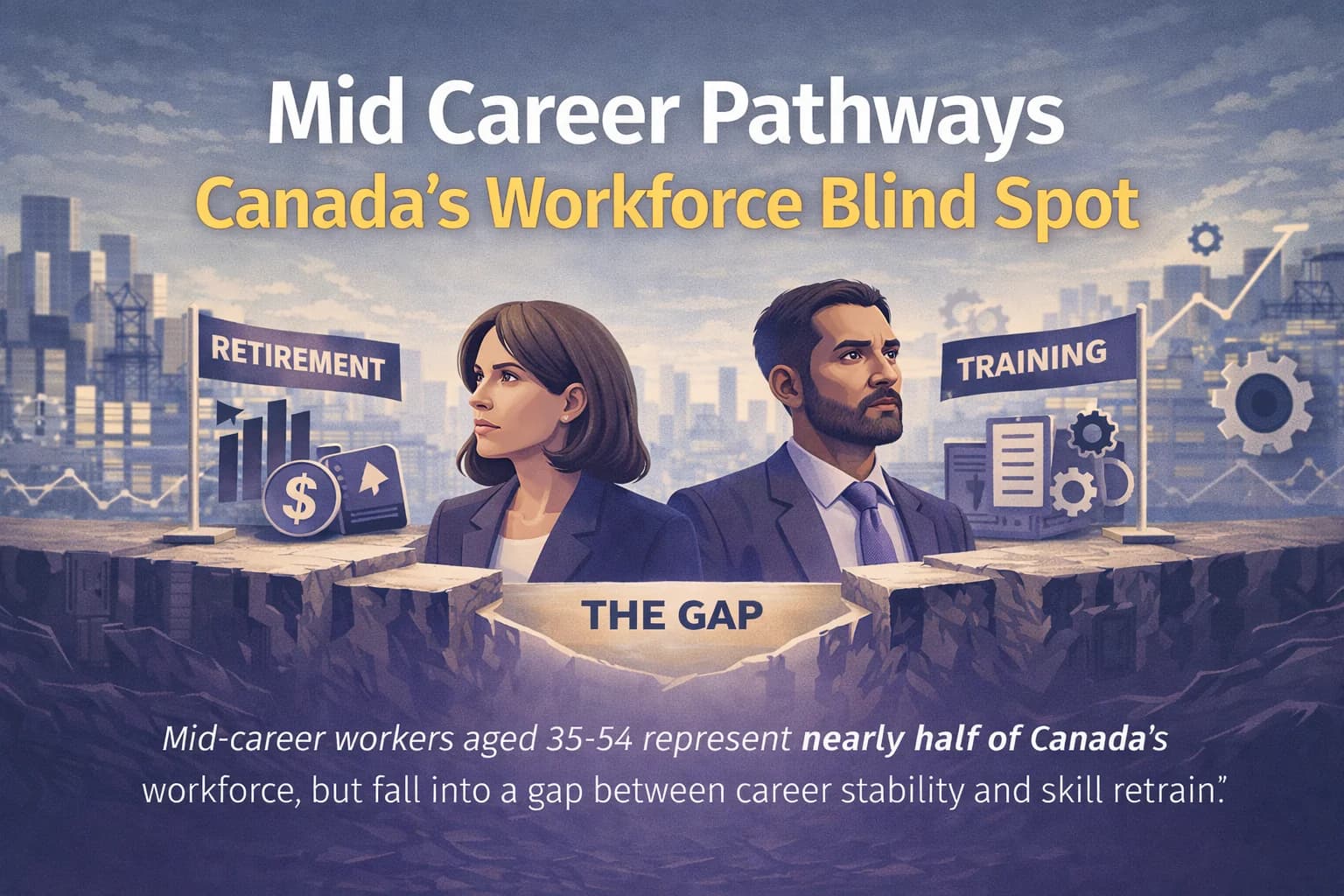
Typically aged 35 to 54, they represent nearly half of Canada's workforce. They are experienced, educated, and actively contributing to the economy. They are also among the most exposed to disruption.
The Gap No One Designed For
Mid career workers sit in a difficult position.
They are often too early for retirement focused support, but not positioned to easily step away from work to retrain. Financial responsibilities make full time reskilling unrealistic. At the same time, training systems are not designed for people balancing careers, families, and income stability.
The result is a persistent gap. Supports tend to arrive after disruption. By then, workers are already navigating financial pressure, uncertainty, and limited time to respond.
The question is not whether support exists. It is whether it arrives early enough to matter.
What Is Starting to Emerge
A consistent theme is becoming clearer. What matters is not more programming. It is better alignment. Efforts that engage employers early, reflect real time demand, and create clear pathways tend to be more effective. Those built in isolation often struggle to translate into actual job transitions.
There is also a growing recognition that mid career transitions are not just about training. They are about navigation. Workers need to understand where their skills apply, what roles are viable, and how to move between sectors. Without that clarity, even well designed programs can fall short.
The System Challenge
Canada has programs. It has funding. It has service delivery. Relationships take time, while disruption moves quickly. The systems that connect employers, workers, training providers, and policymakers are fragmented. This creates a mismatch between the pace of change and the pace of response. This is not just a workforce issue. It is a systems design issue.
As labour market volatility increases, the focus is starting to shift toward earlier intervention, stronger employer alignment, and more coordinated approaches.
Mid career workers are not lacking skills. They are navigating systems that were not built for the speed or complexity of today's economy.